Binocular Vision Problems in Children: When the Eyes Don’t Team Well
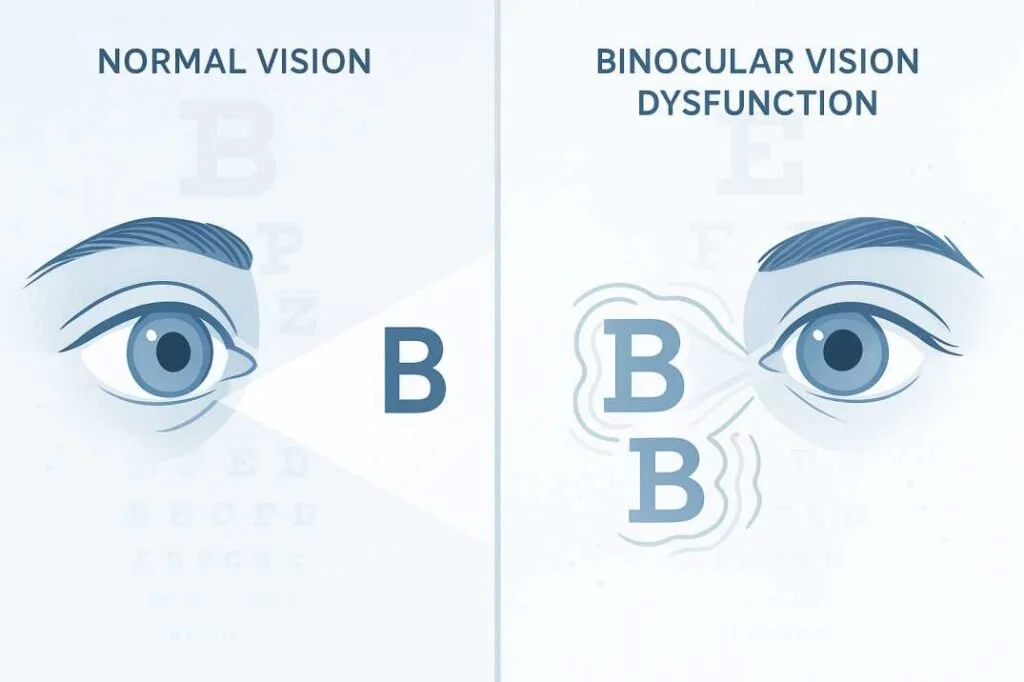
When we say binocular vision, we’re talking about eye teamwork: the ability for both eyes to aim at the same target and send the brain one clear, comfortable image. This matters a lot in childhood because kids are building the visual skills they’ll use for reading, learning, sports, and everyday coordination (Donahue et al., 2016).
Additionally, a child can have “20/20” on a quick screening and still struggle with binocular vision. That’s because many screenings focus on distance clarity, not how well the eyes work together at near.
How common is this?
One of the most studied binocular vision issues in kids is convergence insufficiency (CI): when the eyes have trouble turning inward together for near tasks like reading.
A large school-based study of 5th and 6th graders found that about 13% met criteria for convergence insufficiency (Rouse et al., 1999). That’s roughly 1 in 8 kids and many of them won’t say ‘I see double.’ They’ll just avoid reading or feel tired doing it.
Other binocular-related childhood conditions are also common in the U.S.:
Strabismus (eye misalignment) is estimated to affect about 4% of the U.S. population (American Association for Pediatric Ophthalmology and Strabismus, 2024).
Amblyopia (“lazy eye”) is found in about 2% of U.S. children aged 6 to 72 months, and it’s a leading cause of vision loss in kids (Prevent Blindness, n.d.).
What binocular vision problems can look like in real life
This is the tricky part in my opinion. Binocular vision problems will often show up as school or comfort problems, not as a child reporting that their vision is blurry.
Things that are important to pay attention to (and what parents/teachers often notice) include:
headaches or eye strain after reading/near work
losing place when reading, skipping lines, needing a finger as a guide
avoiding books/homework
words that blur, move, or double during near tasks
closing one eye, tilting head, rubbing eyes a lot
These are exactly the kinds of signs that don’t always show up on a standard distance eye chart, which is one reason comprehensive eye evaluations matter in pediatrics (Donahue et al., 2016).
Binocular vision problems are not rare edge cases. They’re a real part of pediatric eye care, and they can affect comfort, learning, and confidence especially when a child is doing hours of near work in school.
This page is the big picture intro. Later, I’m going to dive into specific sections on:
Convergence insufficiency (what it is + why reading feels harder)
Accommodative (focusing) problems and why they often overlap
Signs by age (preschool vs. school-age vs. teens)
Why screenings miss this (and what exams check instead)
I will add hyperlinks once I have completed my research and added these sections!