Before pediatric optometry was a specialty (1890s–1930s)
When people talk about pediatric optometry today, it usually sounds like a clearly defined specialty. But if you go back far enough, that label didn’t exist at all. What did exist were schools, teachers, and families noticing that a lot of kids weren’t seeing well—and that it was affecting how they functioned in class.
That’s really where this story starts!
Early optometry and children
At the end of the 19th century, optometry itself was still becoming an organized profession in the United States. National professional groups were forming, including organizations that would later evolve into the American Optometric Association (American Optometric Association, n.d.). At that point, optometrists weren’t specializing in pediatrics, but children were already part of their patient population—mostly because families brought kids in when school became difficult.
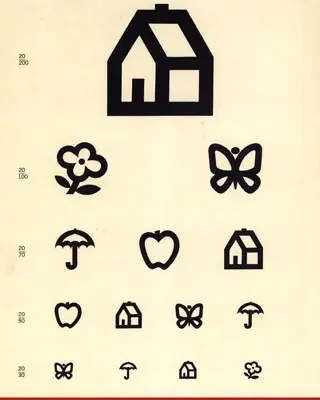
School vision screening shows up early
One of the earliest documented public efforts to address children’s vision happened through schools. Historical accounts describe Connecticut implementing a statewide school vision screening program in 1899, often cited as the first of its kind in the U.S. (Appelboom, 1985).
A 1928 study found that about 45% of schoolchildren had some vision issue, which really grabbed the public’s attention. This era saw the birth of what was called ‘sight conservation’ movements in schools. Nurses, teachers, and volunteer eye doctors began screening kids, though the quality of early screening was hit-or-miss (Gioia et al., 2018).
These early screenings were basic. They weren’t comprehensive eye exams, and accuracy varied depending on who was testing and how it was done. But the idea itself was important: children’s vision was being treated as something worth checking before problems became obvious.
By the early 1900s, similar programs were appearing elsewhere, even though there wasn’t much consistency yet (Appelboom, 1985).
Notably, in 1943 the American Medical Association (AMA) endorsed a Massachusetts statewide vision testing program in schools (Gioia et al., 2018). With this, school vision screening really took off; within the next two decades most U.S. schools had some form of vision testing for students. This broad public health approach laid the groundwork for pediatric eye care by creating awareness that every child’s vision should be checked.
Vision, learning, and early public messaging
As screening became more common, the connection between vision and school performance started to show up in public health messaging. By the 1920s and 1930s, concerns were growing that vision problems were being mistaken for learning or behavioral issues.
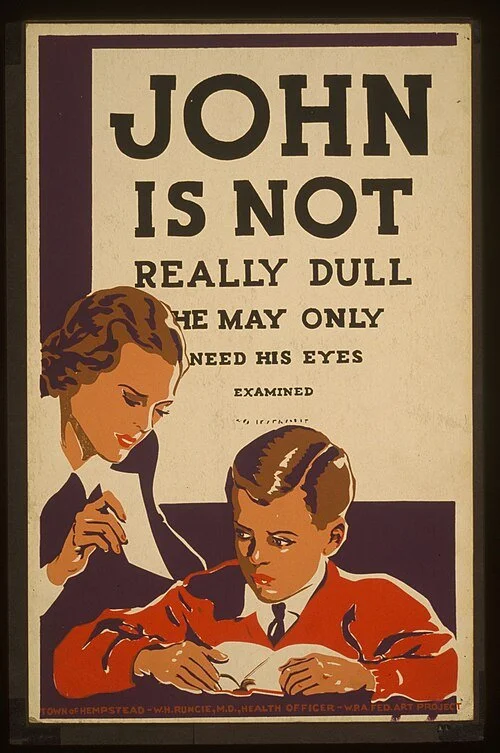
A well-known example from this period is a 1937 WPA poster preserved by the Library of Congress that reads:
“John is not really dull — he may only need his eyes examined.” (Library of Congress, 1937)
It’s a blunt statement, but it reflects how people were beginning to think differently about childhood difficulties. Vision wasn’t just about eyesight, but rather, it could affect how a child was perceived in school.
Where optometrists fit into this
Even though pediatric optometry wasn’t a formal specialty yet, optometrists were already involved once children were identified through screening. When kids failed school vision tests, families needed follow-up care, and optometrists often provided that care through community practices (Appelboom, 1985).
This created an informal but important role for optometry in children’s eye care. Over time, it helped normalize the idea that children should receive professional eye examinations, not just vision checks at school.
Outside North America
In the UK and parts of Europe, a different approach to children’s eye care emerged.
Based on the name alone, what do you think orthoptics involved?
-
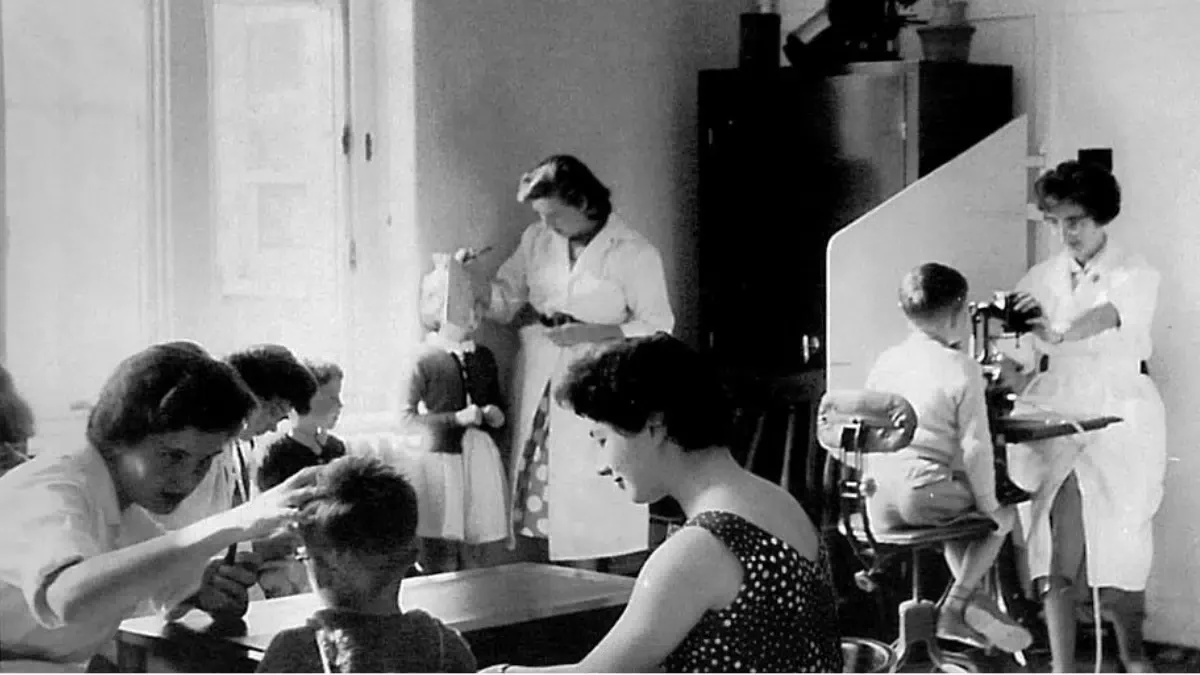
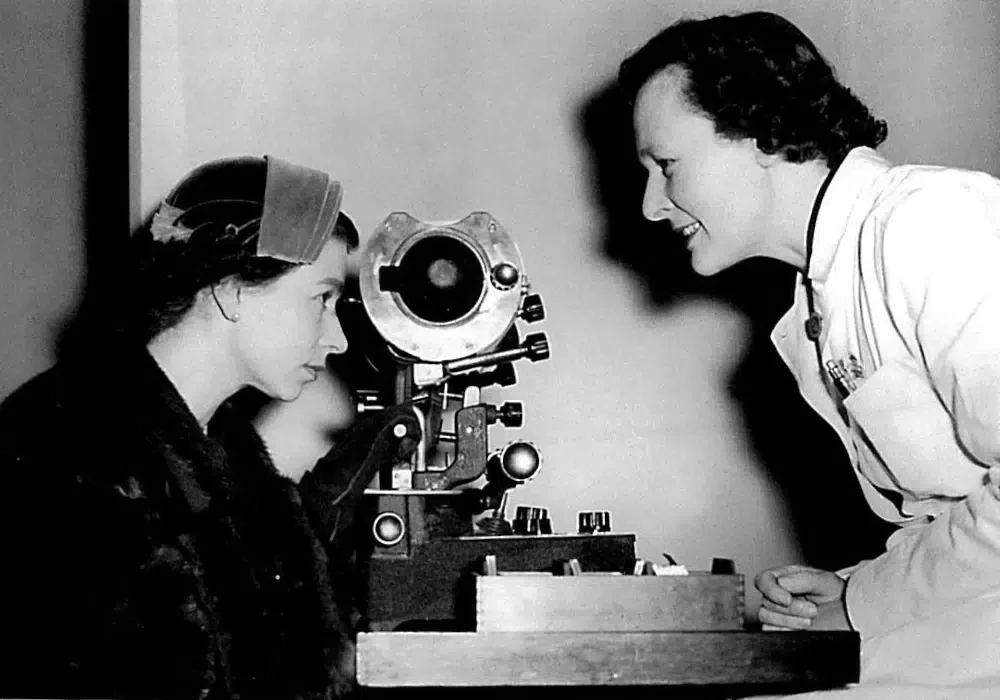
It’s worth noting that children’s eye care developed differently in other parts of the world. In the UK and parts of Europe, a separate approach emerged that focused less on general vision testing and more on how the eyes work together. This approach became known as orthoptics, a profession centered on binocular vision, eye movement, and eye alignment—especially in children.
Orthoptics grew out of ophthalmology in the late 19th and early 20th centuries, as doctors began to recognize that conditions like crossed eyes and “lazy eye” required more than simple observation. Instead, they needed careful measurement, follow-up, and targeted treatment. One early milestone was the opening of an orthoptic clinic in London in 1928 by Mary Maddox, who helped formalize orthoptics as a specialized field within eye care (British & Irish Orthoptic Society, n.d.).
-
From there, the profession continued to develop through dedicated clinics, training programs, and professional organizations. Canada followed a similar path, opening its first orthoptic clinic in Winnipeg in 1937. Orthoptists often worked closely with ophthalmologists, using techniques such as eye exercises, patching, and other non-surgical methods to improve visual coordination and alignment.
This matters because pediatric eye care wasn’t shaped by a single profession or model worldwide. Instead, different systems developed based on local medical traditions, healthcare structures, and ideas about childhood development. Orthoptics became one important pathway—particularly outside North America—for addressing children’s visual development in a more specialized way.
Where this leaves us
By the late 1930s, pediatric optometry still didn’t exist as a named specialty. But the groundwork was there:
school screening programs had drawn attention to childhood vision
optometrists were already seeing children through referrals
vision was increasingly discussed in the context of learning and development
parallel professions were forming elsewhere to address similar problems
The specialty will come later.
This first period is more about recognition than definition!
Next Section: When children’s vision started to become specialized (1940s–1960s) - History of Pediatric Optometry — Part 2